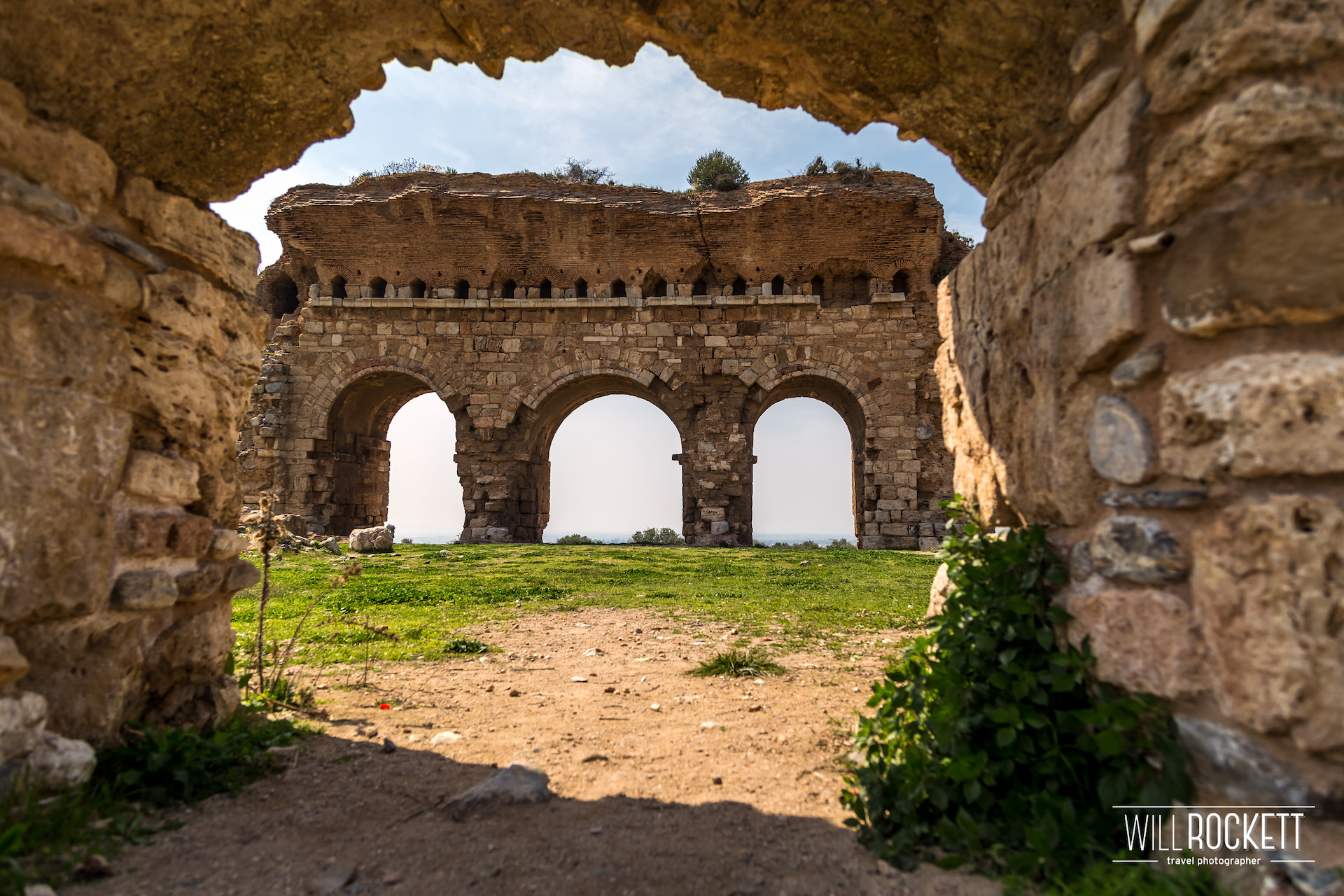
Founded by Argives and Trallian Thracians, the city of Tralles fell to Cyrus and the Persian Empire in 546 B.C.E. Alexander the Great took it in 334 B.C.E. and used it as a military base — a pattern characteristic of his campaigns, establishing strategic strongholds across Asia Minor before advancing further. Tralles later became part of the Pergamene Kingdom after 189 B.C.E. and eventually came under Roman rule.
The ancient historian Strabo recorded Tralles for the great wealth and prosperity of its people, famous in Alexander's time and under the Pergamene kings. Schools of philosophy and art flourished there, and the city was renowned for its pottery. Two of its most famous citizens made their marks in Constantinople rather than their hometown: Anthemius of Tralles, a distinguished mathematician and architect, co-designed the Hagia Sophia cathedral with Isidore of Miletus under the Emperor Justinian I — the building that would stand for centuries as the greatest church in Christendom. Another notable connection: Pythadoris, granddaughter of Marc Antony and wife of the king of Pontus, ruled for four decades as queen, and her grandson Polemon II was briefly married to Bernice — the same Bernice who appears alongside King Agrippa at Paul's hearing in Acts 25.
Tralles in Christian History
The church in Tralles probably traces its origins to Paul's ministry in the region. Acts 18:23 records Paul passing through Galatia and Phrygia "strengthening all the disciples" before reaching Ephesus, likely traveling the Meander River Valley — which would have taken him near Tralles. If the community did not originate directly with Paul, it almost certainly grew from students trained at his school of Tyrannus in Ephesus, or through Epaphras, who traveled the Meander Valley to plant churches in Colossae and beyond.
I know that ye possess an unblameable and sincere mind in patience, and that not only for present use, but as a permanent possession, as Polybius your bishop has shown me, who has come to Smyrna by the will of God the Father. — Ignatius, Letter to the Trallians
When Ignatius was being transported to martyrdom in Rome around 108 A.D., the bishop of Tralles, Polybius, traveled to Smyrna to meet him. In his responding letter, Ignatius addresses church polity, corrects doctrine, warns against the heresy of those who denied the true humanity and death of Christ, and urges the congregation to unity and love. That a city never mentioned in Paul's letters had a bishop organized enough to send a representative to meet a dying church father demonstrates how thoroughly Paul's mission had saturated Asia Minor — the gospel reaching Tralles not through a direct apostolic visit but through the networks and communities his school had established.
Written content courtesy of Ronnie Jones III and Will Rockett, featured in To the Saints in Asia Minor.