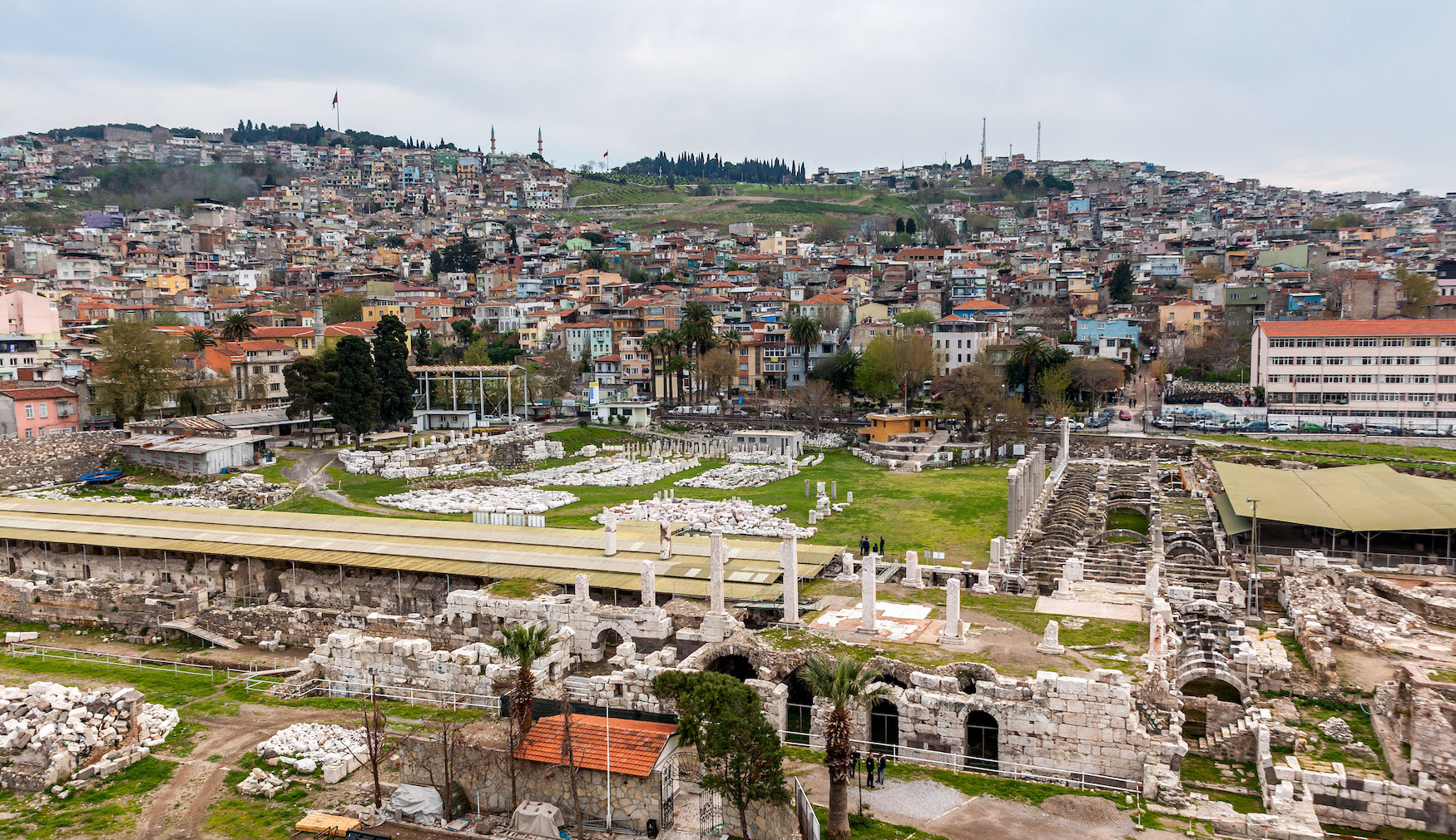
The ancient city of Smyrna occupies two locations — "Old Smyrna," founded in the eleventh century B.C.E. on a site inhabited for more than two millennia before that, and "New Smyrna," rebuilt a few kilometers southwest after a catastrophic earthquake, commissioned by Alexander the Great in the fourth century B.C.E. The fortress he built still overlooks the city. Smyrna claimed Homer as a native son — a boast contested by six other cities, though many scholars accept it. Only sixty kilometers from Ephesus, the two cities maintained an intense rivalry for the title "First City of Asia" that stretched across centuries. Smyrna came under Roman rule in 195 B.C.E. and was rebuilt a final time by Marcus Aurelius in 178 A.D. after another earthquake. The modern city of Izmir's covered marketplace stands on the same grounds as Marcus Aurelius' rebuilt agora — quite possibly one of the oldest continuously used markets in the world.
Smyrna in Christian History
A significant Jewish population had established the cultural and religious groundwork that Paul's mission — radiating out from Ephesus — would have reached early. But Smyrna rose to particular prominence in the generation after the apostles, as a city of martyrs and of the church's most celebrated bishop.
John's letter to Smyrna in Revelation is brief and entirely without rebuke. To a church experiencing poverty and persecution, he says simply: do not fear. Be faithful unto death. The crown of life awaits.
Do not fear what you are about to suffer. Behold, the devil is about to throw some of you into prison, that you may be tested, and for ten days you will have tribulation. Be faithful unto death, and I will give you the crown of life. — Revelation 2:10
Polycarp, bishop of Smyrna from approximately 69 to 155 A.D., was a disciple of the Apostle John — ordained by the apostle himself, according to multiple church fathers including Irenaeus, Tertullian, and Jerome. From Smyrna, Ignatius summoned church leaders from across Asia Minor to visit him on his way to martyrdom in Rome, and wrote several of his surviving letters from the city. Polycarp helped the church navigate the heresies of Marcion and the Gnostic Valentinus, and his Letter to the Philippians is a document of major importance for understanding how the New Testament canon was formed. When the authorities demanded he renounce Christ to avoid death, Polycarp replied: "Eighty-six years I have served him, and he has done me no wrong. How can I blaspheme my King who saved me?" He was burned and then stabbed. The church he led is still the church that meets in Izmir today.
Written content courtesy of Ronnie Jones III and Will Rockett, featured in To the Saints in Asia Minor.