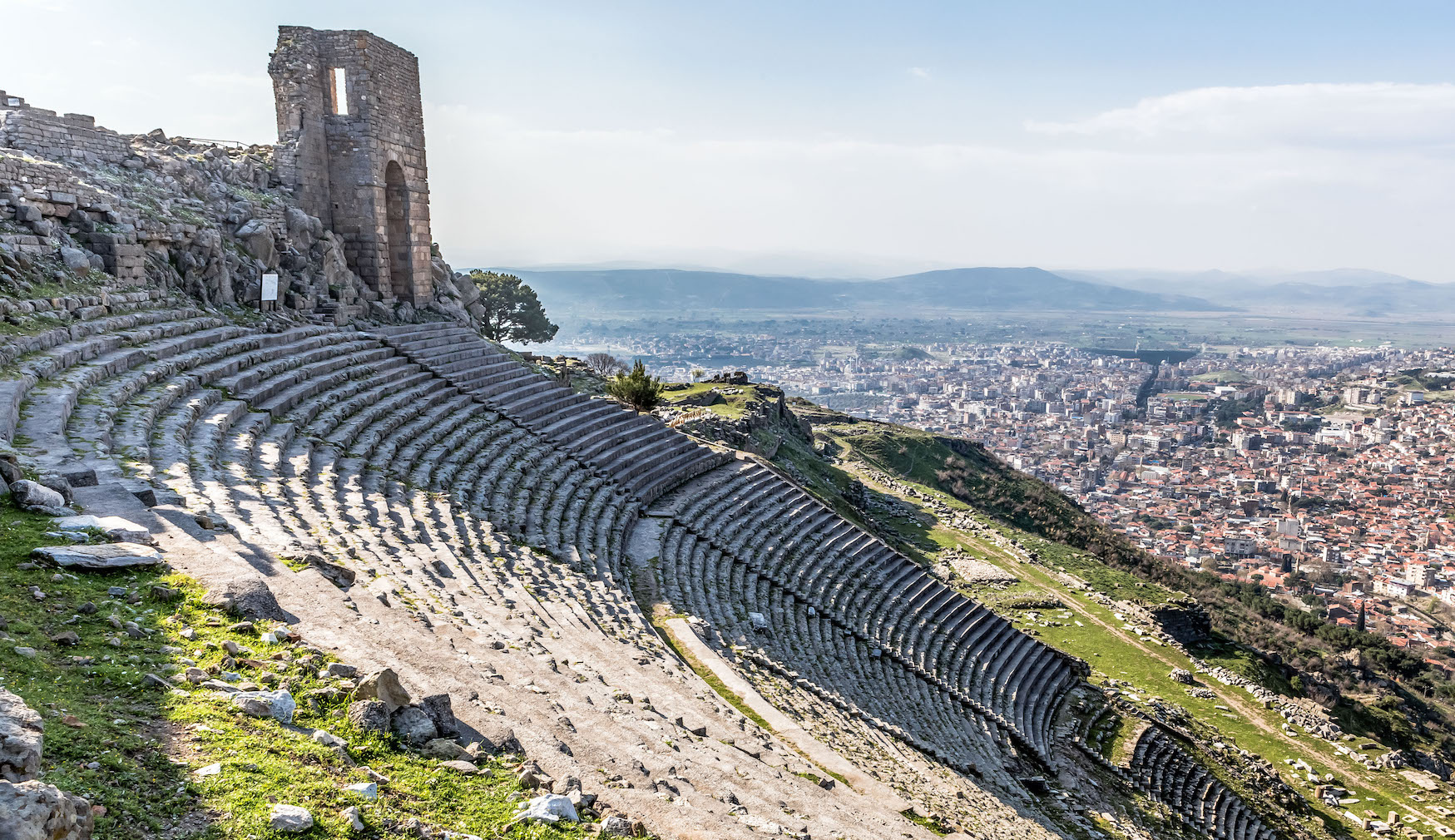
Mythology surrounds the founding of Pergamum. Legend claimed it was established by Telephus — king of Asia Minor, son of Hercules, grandson of Zeus — a lineage that gave its rulers grounds to claim divine authority. The name derives from the Greek word for "citadel," fitting for a city whose acropolis crowns a hill 1,300 feet above the valley. Archaeological evidence points to settlement from the eighth century B.C.E., though Greek history first mentions Pergamum when soldiers passed through it en route to fight the Persians in 399 B.C.E.
The city's defining dynasty began with a betrayal: one of Alexander the Great's generals was overthrown by his officer Philetaerus, who launched the 150-year Attalid dynasty in 281 B.C.E. The Attalids defeated the invading Gauls from Galatia and erected the famous Altar of Zeus as a memorial to that victory — the altar that most scholars believe Christ references in Revelation as "Satan's throne." The Asklepion, one of the ancient world's earliest and most celebrated medical centers, drew emperors and philosophers to Pergamum for treatments ranging from herbal remedies and therapeutic baths to dream interpretation. The serpent — emblem of Asclepius — wrapped around a rod remains a symbol of medicine to this day.
Pergamum in Christian History
The church at Pergamum endured what John describes as the most intense opposition of any community he addresses in Revelation. They lived, he writes, "where Satan's throne is" — most likely a reference to the Asklepion, whose presiding deity Asclepius was sometimes called a savior and whose emblem was the serpent of Eden.
I know where you dwell, where Satan's throne is. Yet you hold fast my name, and you did not deny my faith even in the days of Antipas my faithful witness, who was killed among you, where Satan dwells. — Revelation 2:13
Tradition holds that John himself ordained Antipas as bishop of Pergamum. In 92 A.D., Antipas was martyred — burned, according to tradition, in a bronze bull-shaped altar used for exorcism. John honors him as "my faithful witness," the same word used for Christ himself in Revelation 1:5. At least three other prominent Christians — Carpus, Paylus, and Agathonice — are believed to have been martyred at Pergamum during the reign of Marcus Aurelius. Even so, John rebukes the church for tolerating false teaching: the doctrine of Balaam and the teaching of the Nicolaitans. Endurance under persecution and doctrinal laxity are not mutually exclusive — a warning the church in every generation needs to hear. The governor Pliny's letter to the Emperor Trajan about the spread of this "superstition" to cities, villages, and farms across Asia Minor suggests that the gospel continued advancing despite everything Pergamum's authorities did to contain it.
Written content courtesy of Ronnie Jones III and Will Rockett, featured in To the Saints in Asia Minor.