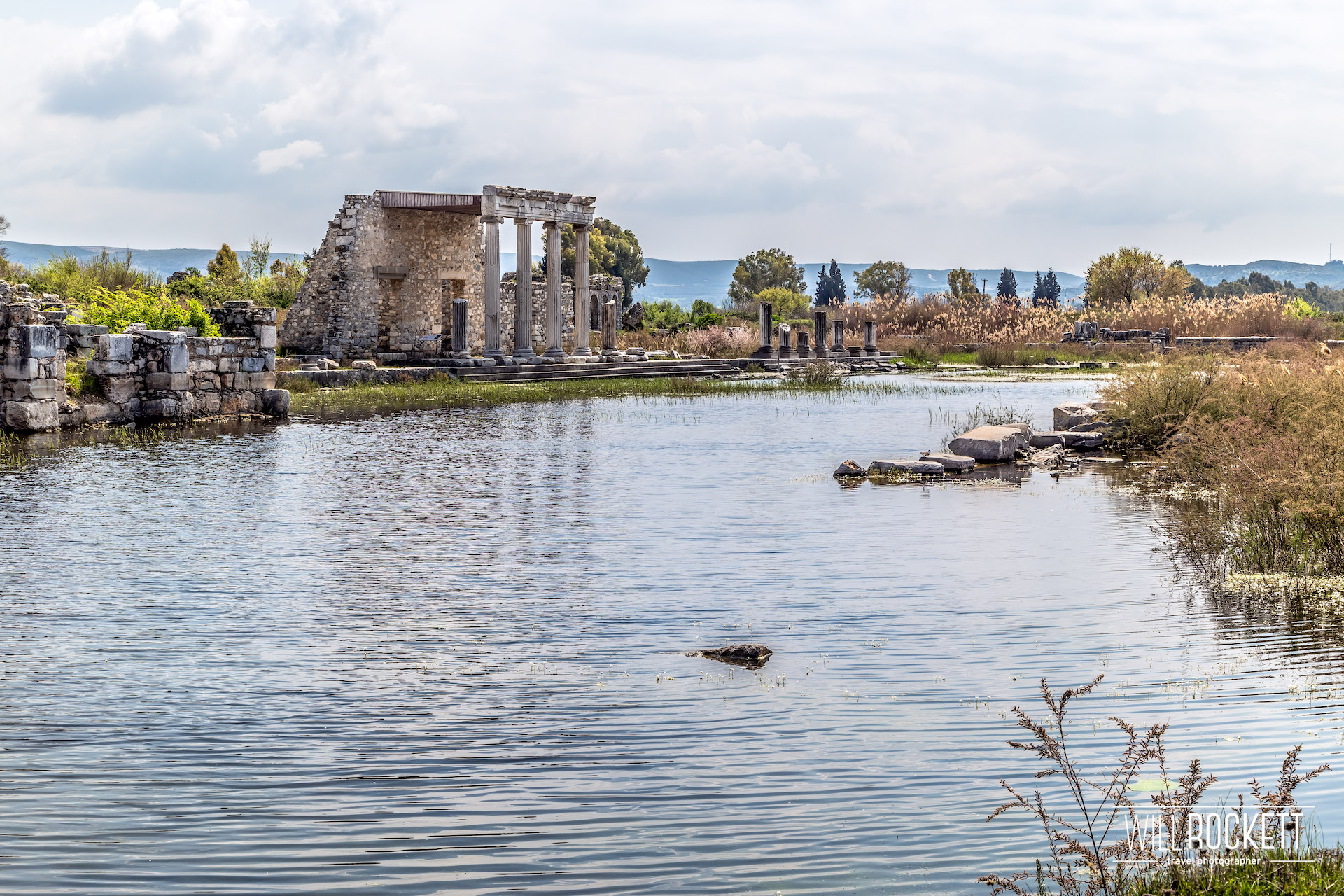
Miletus sits at the mouth of the Menderes River, twenty miles south of present-day Söke. Once one of the most powerful cities on the Aegean coast, it produced philosophers, city planners, architects, and rebels, and hosted emperors, conquerors, and apostles. Archaeological evidence points to Minoan settlers from Crete arriving in the sixteenth century B.C.E., followed by the Mycenaeans, then the Ionians around 1000 B.C.E. Like most cities of the region, Miletus passed through Persian, Alexandrian, Seleucid, and finally Roman control. Its undoing was geological rather than military: the slow silting of the Meander River filled its harbors, distanced it from the coast, and destroyed the economic foundation on which the city had been built.
Miletus was celebrated for its intellectual contributions. Among its famous citizens were Anaximander and Anaximenes, philosophers of the natural world; Hekataios, the historian who first used the word "history" in its modern sense; and Hippodamus, whose grid-based urban planning gave city planners a template still in use today. The Sacred Way connecting Miletus to the oracle at Didyma was one of the ancient world's great processional routes. The oracle at Didyma was consulted by Diocletian as he contemplated the empire's persecution of Christians in 303 A.D.; the oracle reportedly affirmed the persecution. God's people in this region understood what it meant to live in a land where the powers of the age were arrayed against them.
Miletus in Christian History
The importance of Miletus in Christian history lay not in receiving an apostolic letter but in its proximity — geographic and relational — to Ephesus, the hub of Paul's mission in Asia.
On his third missionary journey, Paul was hurrying to reach Jerusalem by Pentecost. He bypassed Ephesus to avoid delay, but paused at Miletus and summoned the Ephesian elders to meet him there. Acts 20 preserves his farewell address to them — one of the most moving passages in the entire New Testament, a pastor speaking to pastors, knowing he would not see them again.
I know that after my departure fierce wolves will come in among you, not sparing the flock; and from among your own selves will arise men speaking twisted things, to draw away the disciples after them. Therefore be alert. — Acts 20:29–31
Paul left Trophimus ill in Miletus on a later visit (2 Timothy 4:20), suggesting an established Christian community there capable of providing care. The proximity of Miletus to Ephesus means it almost certainly received the gospel through Paul's school of Tyrannus, even without a direct apostolic commission. That pattern — the gospel radiating outward from a center, reaching places that never received an apostle in person — is the pattern by which the church has always grown, and continues to grow today.
Written content courtesy of Ronnie Jones III and Will Rockett, featured in To the Saints in Asia Minor.