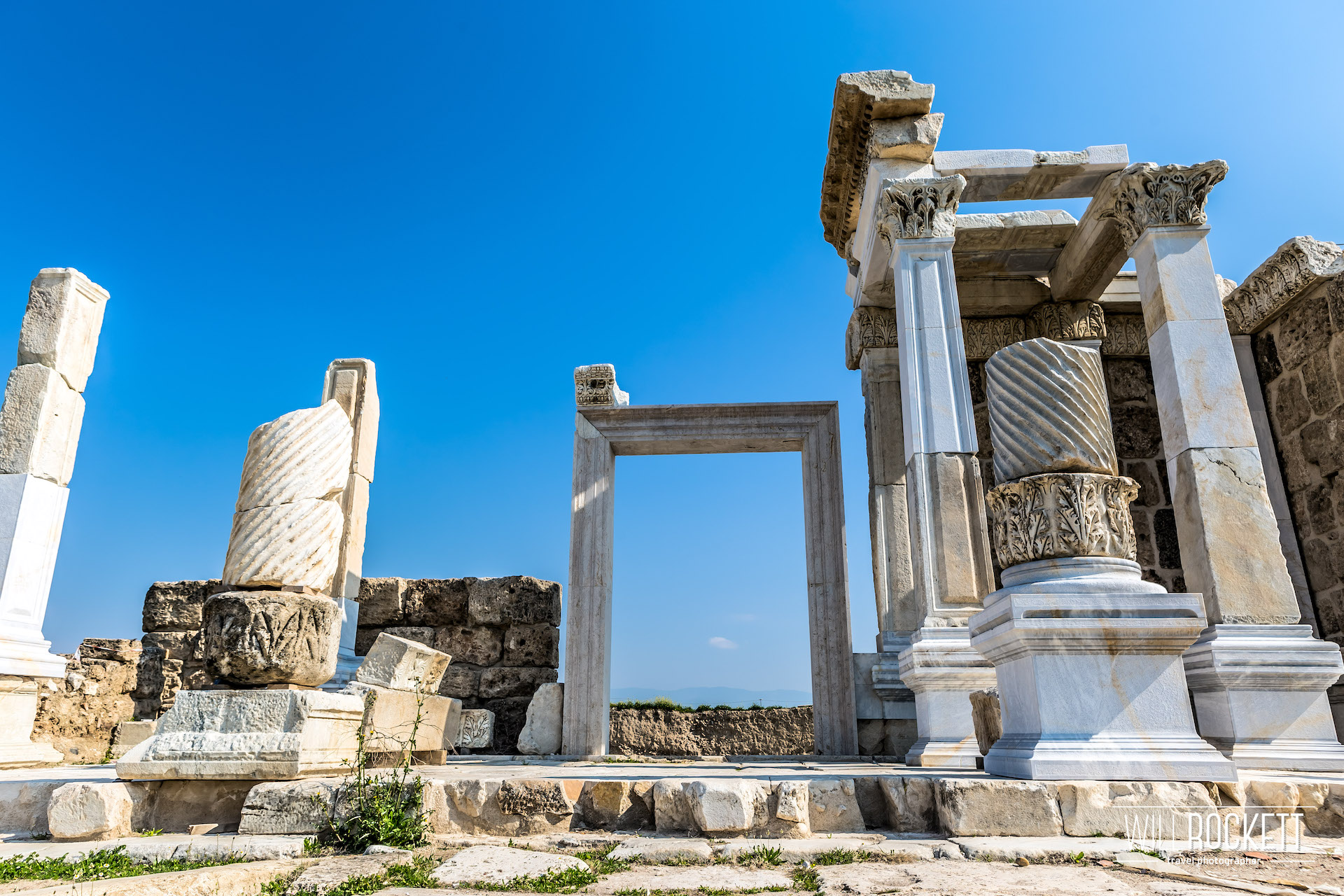
Founded in the third century B.C. by Seleucid King Antiochus II and named for his wife Laodice, the city on the Lycus River became one of Asia Minor's most important commercial centers. It was renowned for its raven-black wool and textiles, its medical school, and its position as a banking center. A devastating earthquake in 60 A.D. leveled the city during Nero's reign; the citizens rebuilt it entirely at their own expense — a detail that illuminates both their wealth and their pride. A later earthquake in the fifth century destroyed it permanently, and the population dispersed to nearby settlements including modern Denizli.
At its height, Laodicea boasted two theaters, four bath complexes, five agoras, five fountains, and monumental colonnaded streets. Its ancient stadium — one of the largest in Anatolia at 285 by 70 meters — could hold between twenty and twenty-five thousand spectators. In 26 B.C.E., the city competed against ten others in Asia Minor for the honor of building a temple to the Emperor Tiberius. Smyrna was awarded the privilege; Laodicea was rejected for insufficient resources. The city's pride never recovered from the slight.
Laodicea in Christian History
Laodicea stood at the geographic and spiritual center of the Lycus Valley's tri-city community. Cold mountain springs flowed through Colossae on one side; the famous hot springs of Hierapolis rose on the other. Laodicea's own water supply came by aqueduct from a distant source, arriving tepid and mineral-laden. Christ's letter to the church in Revelation 3 draws directly on this geography: the community that was "neither hot nor cold" but lukewarm was living in a city whose very water supply illustrated the condition.
Epaphras, trained in Paul's school at Ephesus, most likely planted the church in Laodicea, as he did in the neighboring cities. Paul never visited the Lycus Valley churches but felt deep apostolic responsibility for them — writing in Colossians of his intense struggle "for you, for those in Laodicea, and for all who have not seen me in person" (Colossians 2:1). He addresses a letter to them in Colossians 4, and the church first gathered in the home of Nympha, whom he greets by name.
Epaphras, who is one of you, a servant of Christ Jesus, sends you greetings. He is always wrestling for you in his prayers, so that you can stand mature and fully assured in everything God wills. — Colossians 4:12
Despite the sharp rebuke of Revelation 3, Christianity persisted in Laodicea. The city's bishop Sagaris was martyred. A controversy over the celebration of Passover forced a church council in the fourth century. The church that Christ threatened to spit from his mouth continued, imperfectly, to meet in his name — a reminder that even the severest correction in Scripture is addressed to a community Christ refuses to abandon.
Written content courtesy of Ronnie Jones III and Will Rockett, featured in To the Saints in Asia Minor.