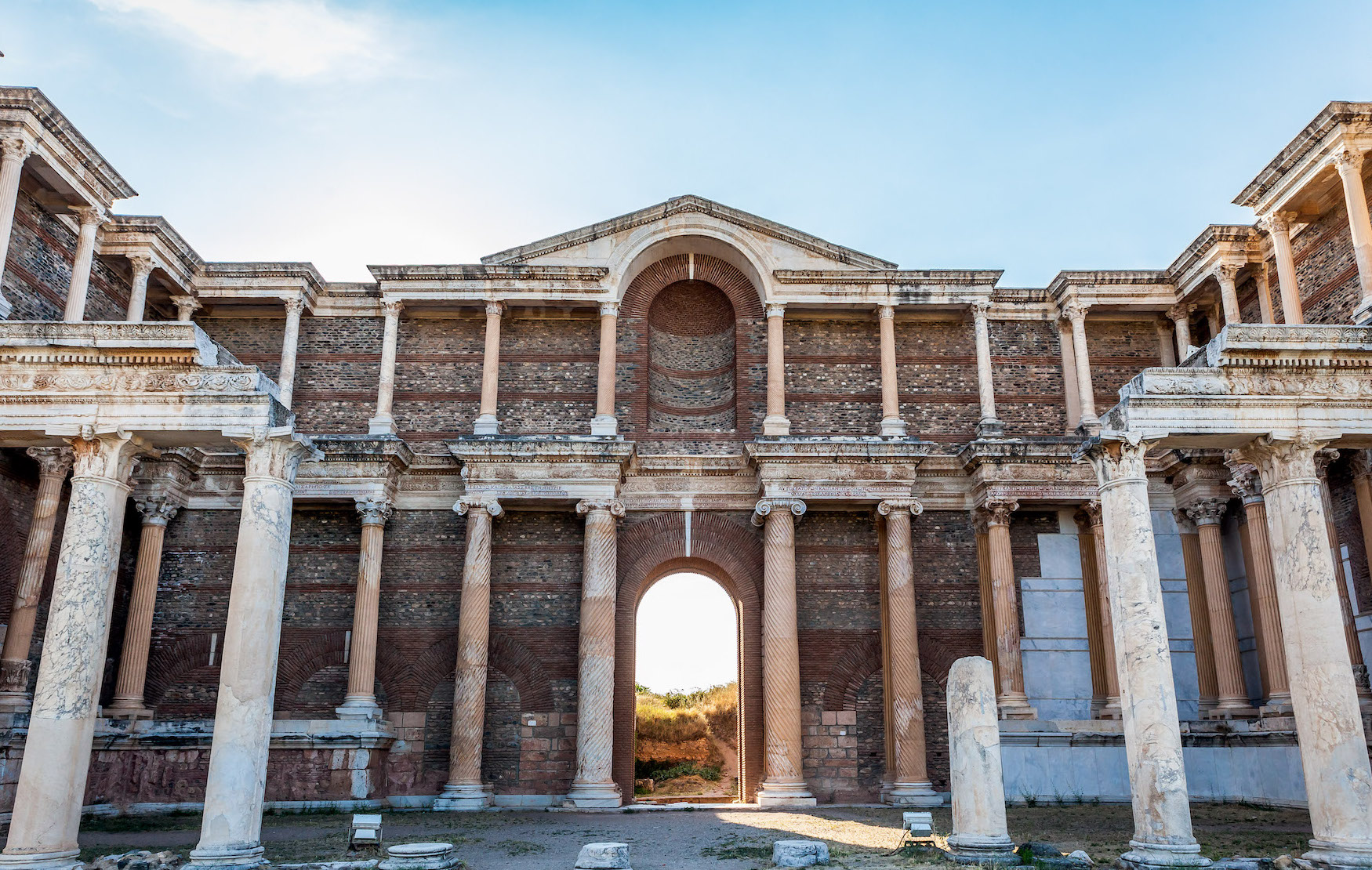
Sixty miles east of modern Izmir, Sardis was one of the ancient world's wealthiest cities — capital of the Lydian kingdom and home to King Croesus, considered the richest person in the world in his time. Sardis is credited with minting the world's first gold and silver coins, generating the myth of Midas and the golden touch connected to the nearby Pactolus River. The city changed hands with the regularity of any strategically located prize: Cyrus the Great took it in 547 B.C., Darius and Xerxes used it during the Greek-Persian wars, and Alexander took it in 334 B.C. The Romans gave it to the Pergamene King Eumenes II before it eventually came fully under Roman rule. A devastating earthquake in 17 A.D. destroyed it; the Emperor rebuilt it. Sardis never recovered its former glory, though it remained an important administrative center for centuries. The city continued to be inhabited until the fifteenth century A.D., when the Mongol conqueror Timur obliterated it.
The Temple of Artemis at Sardis was one of the seven largest Greek temples in the world — more than double the size of the Parthenon. Originally built in the fifth century B.C.E., it was rebuilt and renovated over five hundred years. Inside its precincts, a Byzantine church was later built — the collision of these two structures in a single space is one of the most striking visual illustrations in Asia Minor of the gospel's displacement of pagan religion.
Sardis in Christian History
A large and ancient Jewish community gave the gospel its foothold in Sardis. The historian Josephus records that the Seleucid King Antiochus III relocated two thousand Jewish families to Lydia at the end of the third century B.C., and later Roman decrees guaranteed their right to assemble and send temple taxes to Jerusalem. The prophet Obadiah mentions exiles of Jerusalem in "Sepharad" — another name for Sardis. This deep Jewish presence meant that when the Christian mission arrived, it found familiar ground.
You have a few people in Sardis who have not defiled their clothes, and they will walk with me in white, because they are worthy. — Revelation 3:4
John's letter to Sardis in Revelation is his most searching rebuke: the church has a reputation for being alive, but is dead. Its works are unfinished. It has not stayed awake. And yet within the dead congregation, Christ identifies a faithful remnant — those whose garments are undefiled, whose names will not be erased from the book of life. The severity of the rebuke did not silence the church. Melito, bishop of Sardis in the second century A.D., wrote a defense of Christianity addressed to the Emperor Marcus Aurelius, a beautiful exposition of the unity of Christ's divine and human natures, and extensive work on the Passover controversy. The church that Christ called dead produced one of the most significant theologians of the early period — a reminder that his rebukes are always invitations to repentance and renewal.
Written content courtesy of Ronnie Jones III and Will Rockett, featured in To the Saints in Asia Minor.