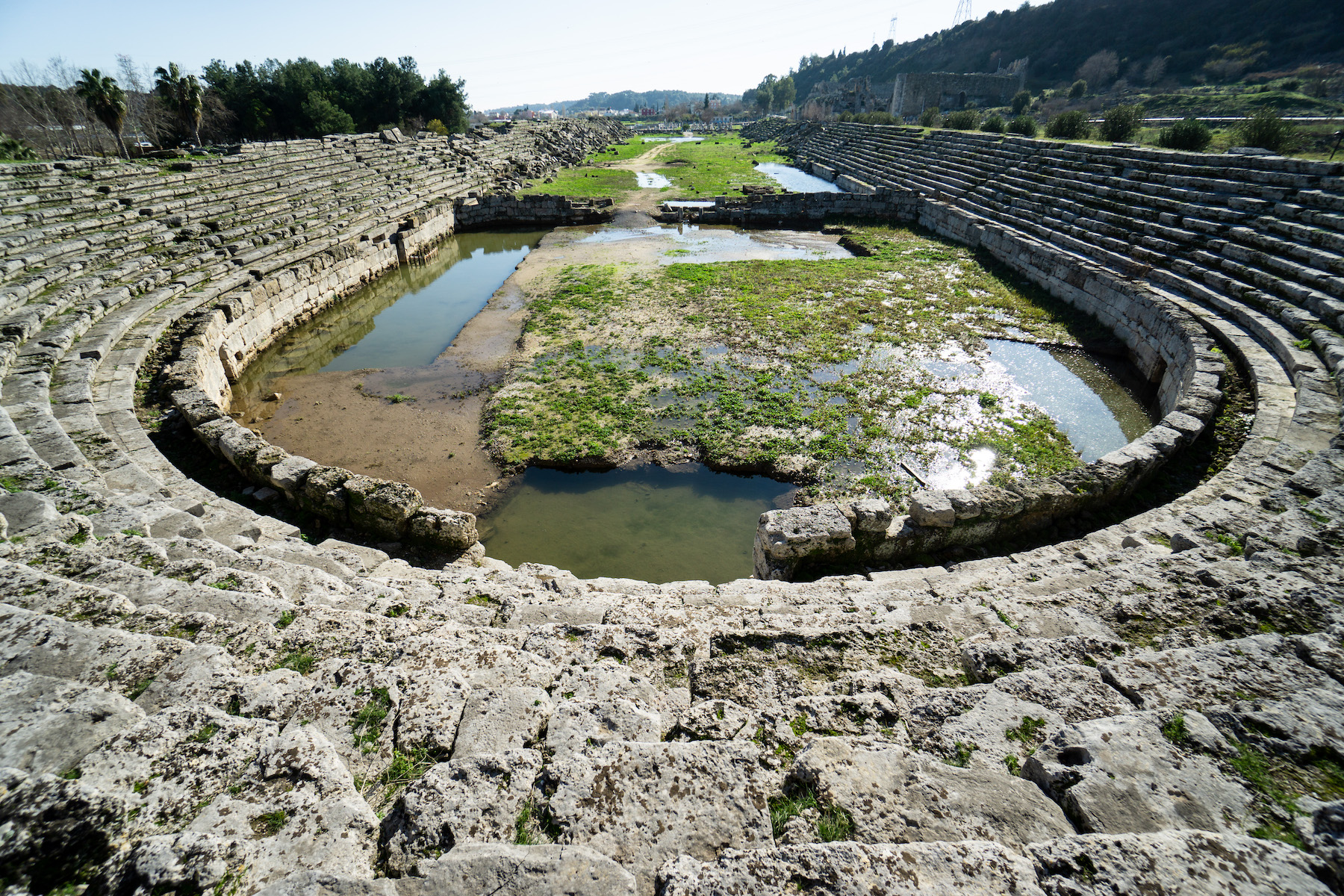
The origins of Perga reach back to a settlement built on a steep-sided mesa — an acropolis in the oldest sense, a high city built for defense. A bronze tablet found in the library of Hattusha, capital of the Hittite Empire, mentions a city named Perha that may be the oldest surviving written record of the place. When Alexander the Great arrived in 334 B.C.E., he stationed troops at Perga while conquering the surrounding plain — the beginning of a Hellenistic period that brought trade, population growth, and grand public buildings to the city.
Perga flourished under Rome. Together with its nearby port of Attaleia, it sat at the head of the Via Sebaste — a road built to connect the Anatolian coast with Roman outposts and the interior city of Antioch in Pisidia. Commerce brought a stadium, theater, and bathhouses. As Roman power faded, Perga dwindled and was eventually abandoned in favor of Attaleia on the coast.
Perga in Christian History
The Via Sebaste was completed in 6 A.D. — one year after the traditional date for the birth of Paul. When Paul and Barnabas sailed from Cyprus to the coast of Asia Minor on their first missionary journey, Perga was the gateway to everything that lay ahead: Antioch in Pisidia, Iconium, Lystra, Derbe.
Acts 13 notes their passage through Perga without recording any preaching there — but it records something else: the departure of John Mark, who left them and returned to Jerusalem. His desertion here would later cause the rift between Paul and Barnabas that ended their partnership. Great missions carry their own tensions. The road that led to the planting of churches across Asia Minor also ran through a painful parting at Perga.
On their return journey, Paul and Barnabas came back through Perga, and this time Acts records that they "spoke the word in Perga" before sailing from Attaleia. The city that had been a stopping point on the way in became a place of proclamation on the way out. The gospel found its way into Perga, as it found its way into every place Paul passed through — not always on the first visit, but eventually.
Written content courtesy of Josh Ryvers, artofwayfaring.com.