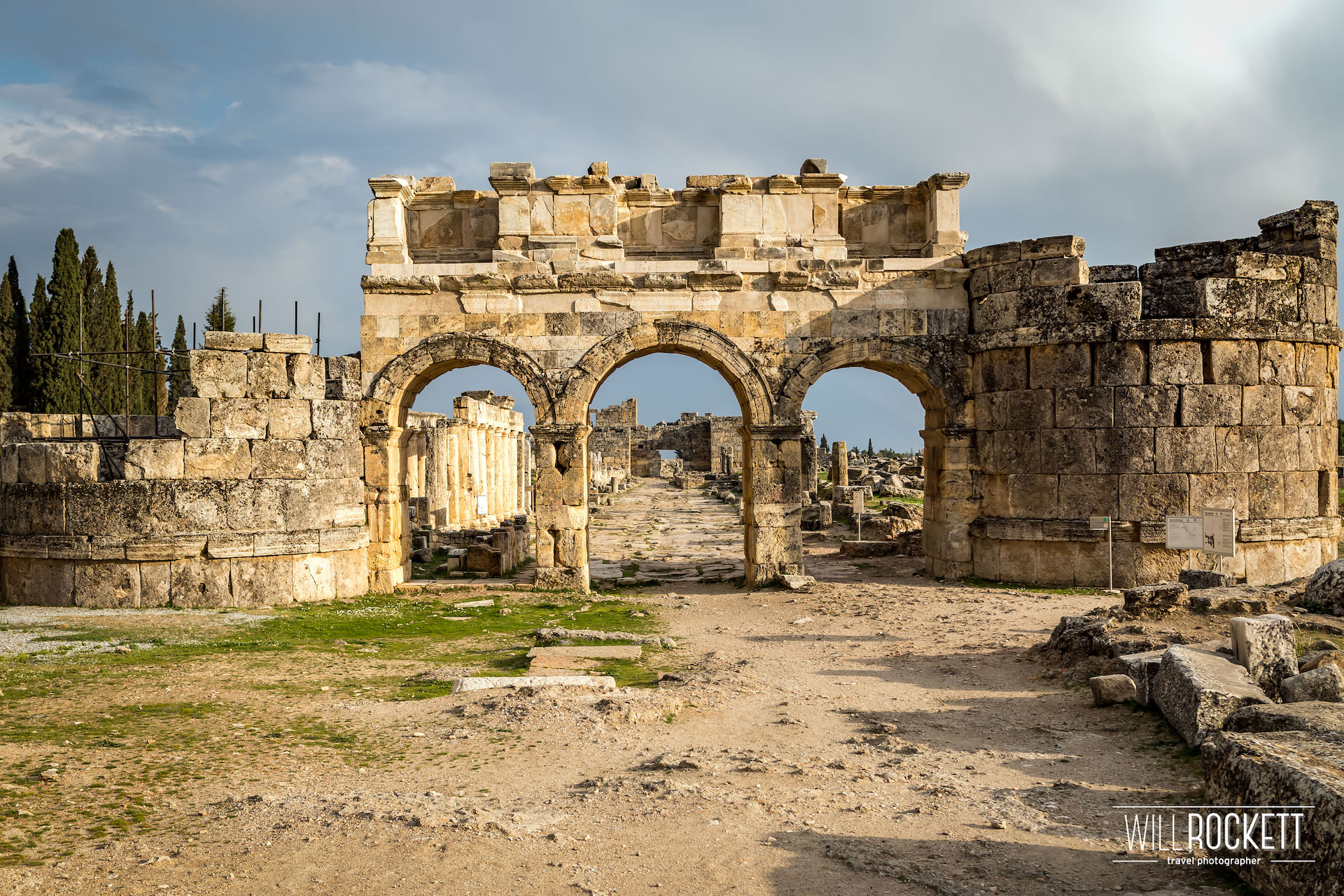
Founded by the Attalid kings of Pergamum in the second century B.C.E., Hierapolis — meaning "sacred city" — was part of the tri-city area in the Lycus Valley alongside Colossae and Laodicea. The name was earned: the city was originally the site of an ancient healing cult centered on its hot springs. Most of the ruins visible today date from the Roman period and spread across a vast hilltop landscape. The hot springs and white travertine formations remain as the tourist attraction now known as Pamukkale — "cotton castle" — famous for both its beauty and its therapeutic waters. The calcium deposits lacing the hillside can be seen from a great distance, giving the illusion of snow even in the height of summer.
Evidence suggests that Asclepius, the god of healing and son of Apollo, had a prominent place in the city, and the theater is adorned with a frieze depicting a sacrifice to Artemis. A temple to Apollo whose ruins are still visible was the founding deity. Nearby, a grotto named the Plutonium — "gate of hell" — was considered a portal to the underworld. The historian Strabo recorded that any animal entering it died instantly. Scientists have since discovered a fissure deep below the site emitting carbon dioxide at lethal concentrations: not a god, but a geological reality that the ancients interpreted through their theology.
Hierapolis in Christian History
Hierapolis stands between Laodicea and Colossae, geographically and theologically. Christ's rebuke to the Laodicean church in Revelation 3 — that it was neither hot nor cold, but lukewarm — takes on vivid meaning in this landscape: the hot springs of Hierapolis on one side, the cold mountain springs flowing through Colossae on the other, with Laodicea's tepid aqueduct water running between them.
Epaphras, trained by Paul in Ephesus, almost certainly planted the church in Hierapolis, as he did in Laodicea and Colossae. Paul testifies to his tireless labor for these communities (Colossians 4:13). Before 70 A.D., either Philip the apostle or Philip the evangelist settled in Hierapolis and was eventually martyred there. A Martyrium built in his honor in the fifth century still stands today.
I shall not hesitate to put into ordered form for you everything I learned carefully from the elders and noted down carefully, for the truth of which I vouch. For unlike most people I took no pleasure in those who told many different stories, but only in those who taught the Truth. — Eusebius, recording Papias of Hierapolis
Papias, bishop of Hierapolis, was described by Irenaeus as "a hearer of John, and companion of Polycarp." He was among the first church fathers to attribute the Gospel of Mark to the Apostle Peter's testimony — a judgment with enduring significance for how the church understands its written inheritance. Apollinaris, bishop of Hierapolis around 175 A.D., wrote a defense of Christianity addressed to Emperor Marcus Aurelius. The massive churches and Christian monuments excavated at Hierapolis testify that by the fifth century, the faith had taken deep root in this place where the gospel had come through the labor of those trained in Paul's school.
Written content courtesy of Ronnie Jones III and Will Rockett, featured in To the Saints in Asia Minor.