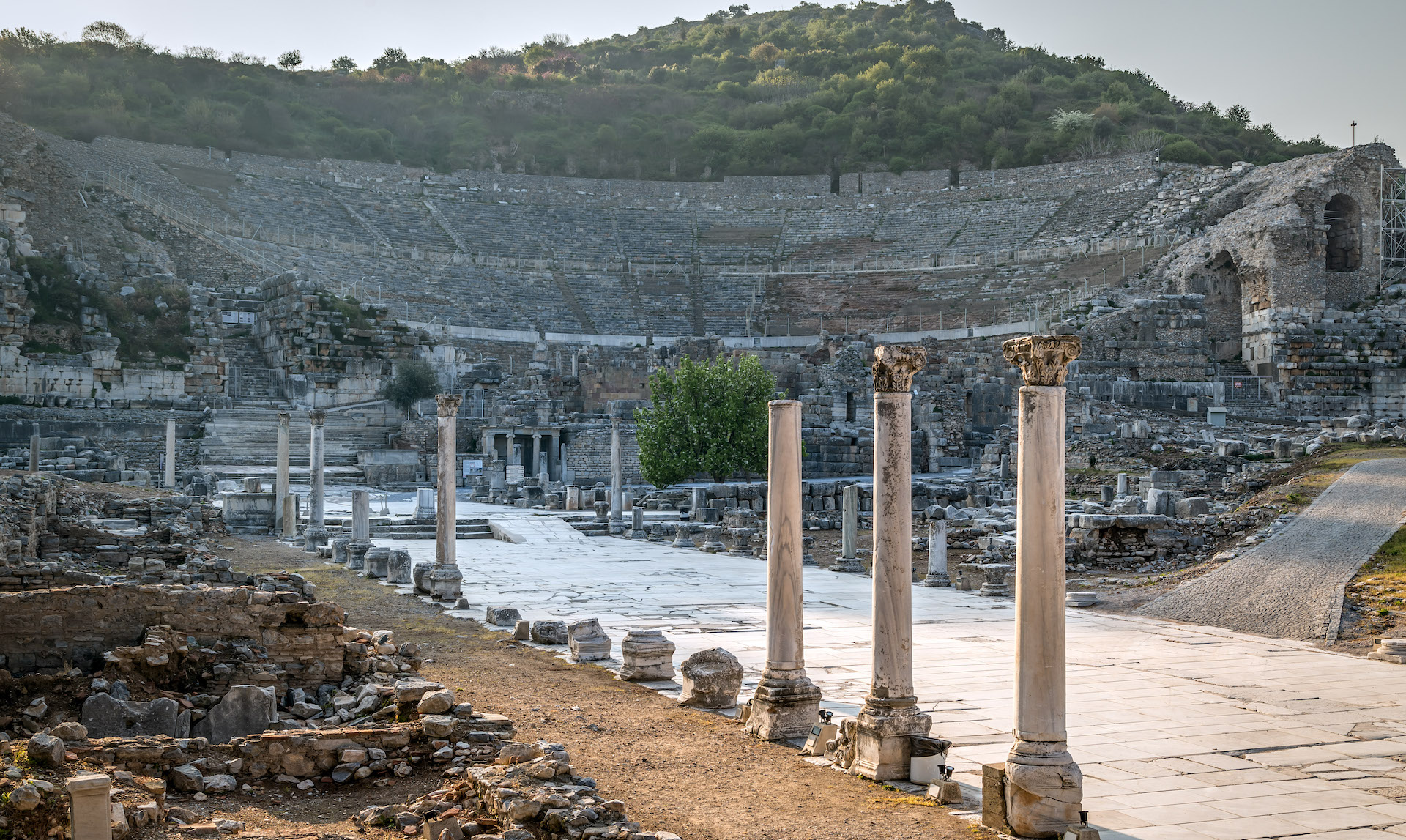
Ephesus stood at the center of commerce, travel, and religion for hundreds — if not thousands — of years in the Aegean region of Anatolia. The city's modern founding dates to around 1000 B.C.E. by the Ionians, though the region had been inhabited for at least a millennium before that. At the heart of Ephesian life was the goddess Artemis, and the temple dedicated to her was, at the time of its construction, the largest in the world — one of the Seven Wonders of the Ancient World.
The Temple of Artemis traces its origins to the Amazon women of Greek mythology, who dedicated a sanctuary to the Anatolian mother goddess Cybele in the same region. Artemis, a similar figure, superseded Cybele in the 8th century B.C.E. and became the defining devotion of the city. The Ephesians so fiercely guarded their role as her guardians that when Alexander the Great offered to fund the temple's rebuilding after its destruction in 356 B.C.E., they refused him — they would not allow a foreign power's name to be attached to their goddess.
Ephesus maintained its prominence into the first century as one of the five largest cities in the Mediterranean world. Cyrus of Persia built the Royal Road connecting Susa to Ephesus when he took the city in 546 B.C.E. Its position as the primary Aegean port made it a prize for successive empires — Persians, Alexander, the Seleucids, the Pergamene rulers, and finally Rome, under whom it became the capital of Asia Minor. The city's eventual decline came not from conquest but from the silting of its harbor, which severed it from the sea and destroyed its economy.
Today Ephesus is one of the most well-preserved ancient sites in the world. The amphitheater, the Library of Celsus, the commercial agora, the terrace homes, and the nearby Basilica of the Apostle John have all been excavated and are open to the public. Walking its marble streets, it is not difficult to feel the scale of what was here — or to understand why it mattered so much to the early church that the gospel took root in this city.
One of Ephesus' own philosophers, Heraclitus, was known as the weeping philosopher. He lamented the immorality of the city, saying its citizens were "fit only to be drowned, and that the reason he could never laugh or smile was because he lived amidst such terrible uncleanness." It was into this city that the Apostle Paul brought the gospel of Jesus Christ.
Paul entered the synagogue and spoke boldly over a period of three months, arguing and persuading them about the kingdom of God... This went on for two years, so that all the residents of Asia, both Jews and Greeks, heard the word of the Lord. — Acts 19:8–10
Paul and the School of Tyrannus
The Apostle Paul spent more time in Ephesus than in any other city on his three missionary journeys. He first came with Priscilla and Aquila on his second journey, engaging briefly in the synagogue before leaving the city (Acts 18:18–20). After Paul's departure, Apollos of Alexandria arrived and preached the gospel — and it was here that Priscilla and Aquila took him aside to correct deficiencies in his theology (Acts 18:24–28).
Paul returned during his third journey and stayed three years (Acts 20:31). After three months in the synagogue, he spent two years reasoning daily in the lecture hall of Tyrannus. From this base, the gospel spread throughout Asia Minor. Paul and his companions sent out Epaphras and others to evangelize the surrounding region — so that, as Acts records, "all the residents of Asia heard the word of the Lord, both Jews and Greeks" (Acts 19:10). This was not a quiet gathering. It was a missionary movement of extraordinary scope, operating from the heart of one of the ancient world's great cities.
The opposition was proportionate. As Ephesians converted to Christianity and abandoned the cult of Artemis, demand for the silver shrines crafted by local tradesmen collapsed. The silversmith Demetrius stirred up a riot, accusing Paul of threatening both the economic and religious life of the city. The protest reached its peak in the 25,000-seat amphitheater, where crowds chanted in honor of their goddess. And yet the church in Ephesus survived, and thrived, and became the hub of Christianity throughout Asia Minor.
Artemis and the Lord of History
The confrontation between the gospel and Artemis in Ephesus is one of the clearest illustrations in Scripture of what it means to say that Christ is Lord over history. Demetrius' complaint revealed the fragility of his goddess: she required her devotees' labor and money to maintain her magnificence. She was, for all her fame, a god who needed her minions.
Today, Artemis is a minor historical curiosity. The temple is rubble. The silversmith guild is long forgotten. The crowds who filled that theater to chant her name are dust. And Jesus Christ, who entered history in the same century those crowds cried out her name, remains Lord of heaven and earth. Ephesians 1 declares him raised "far above all rule and authority and power and dominion, and above every name that is named" — and the ruins of Ephesus are a standing illustration of that claim.
After Paul: Timothy, John, and the Councils
The church in Ephesus did not end with Paul. Timothy spent considerable time as its pastor (1 Timothy 1:3; 2 Timothy 1:18; 4:12), and the Apostle John spent his final years in and around the city. John's supposed burial site is on a hill outside the ancient city, in the ruins of the basilica that bears his name.
Despite the warning of Revelation 2 — that the church had "abandoned the love it had at first" — Christianity continued to take root in Ephesus. In the early second century, the Bishop of Antioch, Ignatius, requested delegates from Ephesus to meet him in Smyrna as he traveled toward his martyrdom in Rome. And in 431 A.D., Ephesus hosted the Third Ecumenical Council, at which Nestorius and Pelagius were condemned as heretics and the doctrines of the divine nature of Christ and original sin were reaffirmed. The city that once chanted for Artemis became the site where the church gathered to define its confession of Christ.
Christianity in the Aegean region of Anatolia traces its roots to Ephesus. From here the gospel moved outward — to Smyrna, to Pergamum, to the churches of Asia Minor addressed in Revelation. The story that began in Ephesus is the story the church today has received and is called to carry forward.
Written content courtesy of Ronnie Jones III and Will Rockett, featured in To the Saints in Asia Minor.