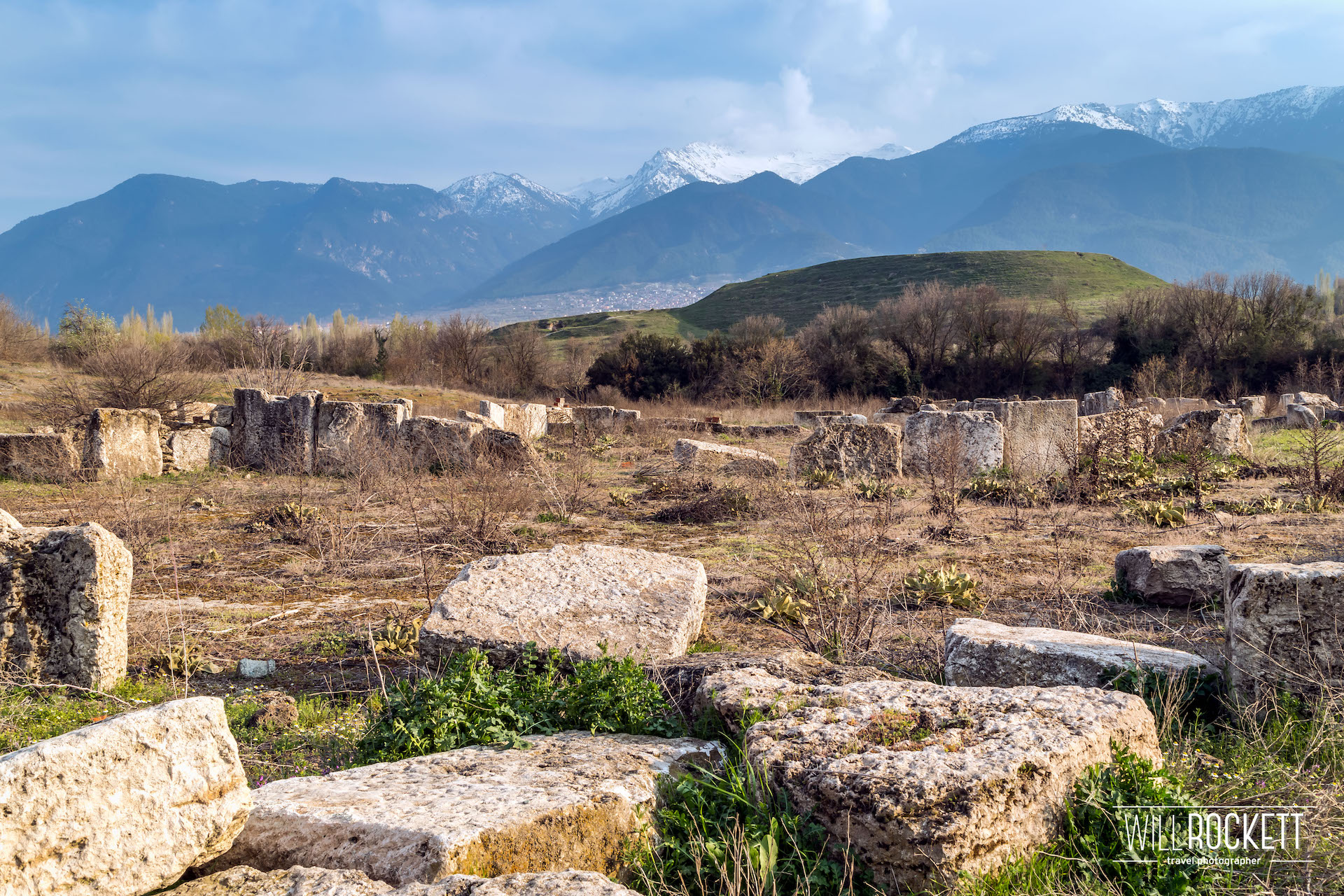
Colossae sits on the Lycus River in the Phrygian region of Anatolia, at the foot of Mount Cadmus where cold mountain springs converge with the river. In the fifth and fourth centuries B.C.E. it was the dominant city of the Lycus Valley — a prosperous center on the trade route from the Aegean to the Euphrates, known for its purple fabric and fine textiles. Xerxes the Great visited in 481 B.C.E. at the city's height; the Persian prince Cyrus the Younger marched through it in 401 B.C.E. But Colossae's prominence did not last. During the Hellenistic and Roman periods, its neighbors Laodicea and Hierapolis surpassed it in influence and industry. The historian Strabo lists it among the smaller villages rather than the great cities of the region. An earthquake in 60 A.D. severely damaged the city, and unlike its neighbors it never fully recovered. Population drifted toward Laodicea and Hierapolis. By the ninth century Colossae was completely abandoned.
Today the ancient site is a low, grassy mound rarely visited. Were it not for its place in early Christian history, Colossae would be another forgotten city whose ruins shelter grazing sheep. Its significance in antiquity was modest. Its significance in the story of the church is extraordinary.
The Letter Paul Never Delivered in Person
Paul almost certainly never visited Colossae. The church there was planted by Epaphras — most likely trained in Paul's school of Tyrannus in Ephesus — who is described as "one of you" (Colossians 4:12), suggesting he was a native of the city. From Paul's letter to Philemon, we can place Onesimus and Philemon himself in Colossae. The network of relationships Paul addresses is intimate and specific: a runaway slave, a householder, a church meeting in a home, a community struggling with ideas that threatened to displace Christ from the center of everything.
Paul wrote Colossians from prison in Rome, around 60–62 A.D. He had never seen their faces. He was writing to a community he knew only through reports from Epaphras and Timothy — and yet his letter contains some of the most exalted Christology in all of Scripture.
He is the image of the invisible God, the firstborn of all creation. For by him all things were created, in heaven and on earth, visible and invisible, whether thrones or dominions or rulers or authorities — all things were created through him and for him. — Colossians 1:15–16
The false philosophies Paul addresses were not abstract intellectual threats. They were rooted in the specific religious culture of Colossae: angel worship, syncretistic practices that blended Jewish, pagan, and early Christian elements, and a tendency to give intermediate spiritual powers a place alongside or above Christ. Paul's response is not to engage the philosophies on their own terms but to set Christ so high that every competing claim is exposed as inadequate. "In him all the fullness of God was pleased to dwell" (Colossians 1:19). There is no room beside him for anything else.
His letter to Philemon, written at the same time and delivered by the same messenger, addresses a single personal situation — a runaway slave being returned to his master — with a pastoral delicacy that has no parallel in Paul's letters. He does not command. He appeals. He offers to cover whatever Onesimus owes. The community shaped by the Christ of Colossians 1 is a community in which the categories of slave and free are being reordered by the gospel.
The Ground Being Opened
For nearly two thousand years, Colossae remained unexcavated — a mound of earth holding whatever the ancient city had left behind. That changed in 2025, when the first formal archaeological season began under the direction of Professor Barış Yener of Pamukkale University.
The findings from the first season have been striking. Seventy early-Roman era tombs were excavated in the city's north necropolis, yielding coins, ceramics, glass bottles, oil lamps, and sandals — the material culture of daily life in the city Paul addressed. But the most remarkable discovery was the sheer density of magical objects: gems, amulets, and other items associated with protective magic, at an intensity Professor Yener describes as "not commonly observed elsewhere in Asia Minor." His assessment: "the findings reveal how much the people of Colossae valued magic, talismans, and objects believed to offer protection. These pre-Christian practices provide essential context for understanding the religious environment in which the early Christian community emerged."
This is not incidental background. It is the excavated evidence of exactly what Paul was writing against. The "philosophy and empty deceit" he warns the Colossians against in chapter 2, the "elemental spirits of the world" he tells them Christ has disarmed, the angel worship and ascetic practices he rebukes — all of it now has a material context recovered from the ground. The letter and the archaeology are in direct conversation.
Dr. Clint Arnold, whose recently published Word Biblical Commentary on Colossians contains a section specifically addressing "Magic, Phrygian Local Belief, Jewish Shamanism, and Syncretism" (pp. 108–146), has noted that these new findings will significantly fill out that picture. The excavation is ongoing, with plans to resume in 2026.
Enjoy Tours was honored to serve as one of the sponsors of the inaugural 2025 excavation season.
The Story Still Unfolding
Colossae is unique among the places in this library. Every other city here has been excavated, studied, and written about extensively for generations. Colossae is being opened now — in our time. The ground that held Paul's letter in its cultural context for two millennia is yielding its contents to archaeologists who can read that letter as they work.
The church that met in Philemon's house in Colossae in 62 A.D., wrestling with philosophies that threatened to displace Christ, is the same church that meets today — still reading the same letter, still being called back to the same Christ who holds all things together. The excavation at Colossae is not just archaeology. It is the living story of the church making contact with its own past, and finding that the past is less buried than it seemed.
Written content courtesy of Ronnie Jones III and Will Rockett, featured in To the Saints in Asia Minor. Excavation update courtesy of Dr. Clint Arnold, Colossae Excavation Project.